First trip to India, January 2015

Day 26, February 3

Jaipur-Hawa Mahal

First trip to India, January 2015

Itinerary

Because of the small window facing a wall, there was no sunlight in the morning and it was very hard to get up. In the end, we got up, finished the cookies, drank some tea, and headed to the center of Jaipur.
Spolied by tourists, the tuk-tuk drivers were demanding 100 rupees to take us to Hawa Mahal, the symbol of Jaipur, which is located right in the center of the Pink City. It’s at most 3 kilometers away; in other towns they would have taken us for 30 rupees, 50 at most. But these guys didn’t even want to bargain, just sat there in their tuk-tuks, and no matter what - 100 rupees to Hawa Mahal. Wolf started getting nervous, though he tried not to show it.
We were standing on the side of the road, under a bridge, not far from the bus station - at a crossroads. It was unclear what to do; taking a ride for 100 rupees was out of the question, because that was simply outrageous. In Ukraine, even a comfortable taxi would be cheaper.
Then some guy came up to Wolf and, pointing at a small bus, a little bigger than our маршрутки, invited us to get in. Wolf, already tired of all the annoying pestering, waved him off out of habit. Although the bus looked trustworthy - it was packed full of ordinary people. I asked whether it went to Hawa Mahal, the guy nodded approvingly, and I suggested to Wolf that we try riding it. We got in. Sat down on the narrow benches fixed along the walls of the bus. We rode and rode, weaving through the streets. People got off and on, and we noticed that everyone was paying an average of 10 rupees for the ride. We paid 20 rupees for the two of us. We followed our route on the navigation app, and when Hawa Mahal was just a short walk away, we decided to get off.

Day 26, February 3

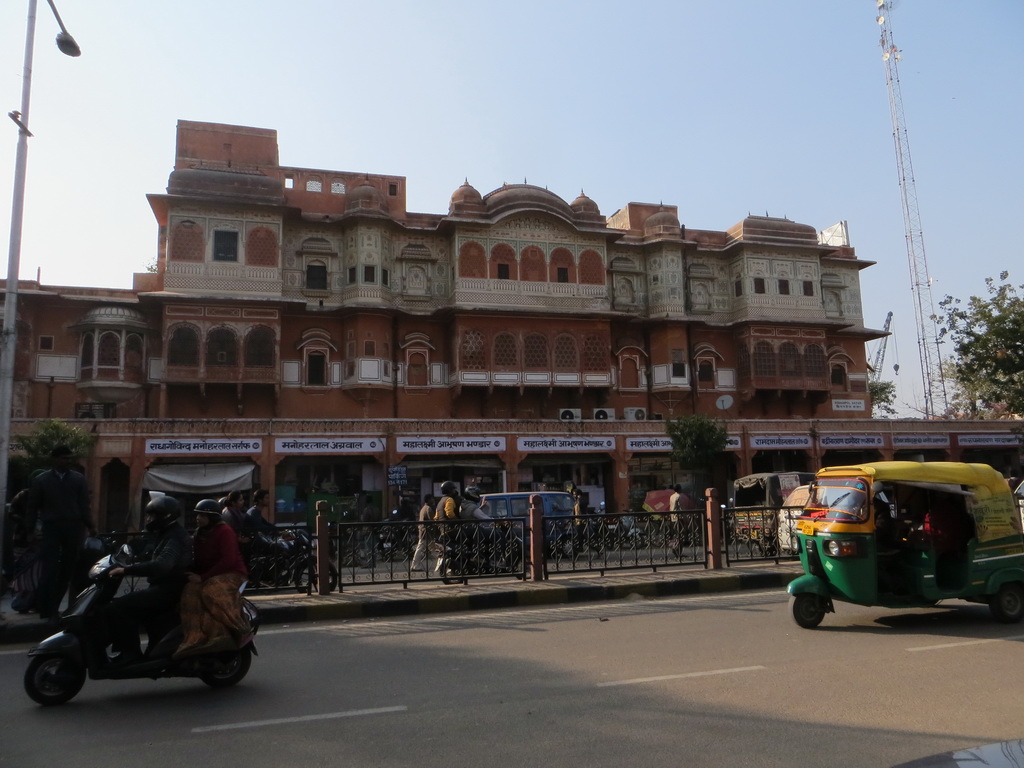
I can’t quite understand why everyone likes Jaipur so much, or maybe people just haven’t seen anything else? The center of the old city is indeed pink, or rather dirty pink. The houses are cute, but after what we saw in less hyped places, there’s nothing special about it. The whole center is one big market. There’s everything here: fabrics, silver, frying pans, bracelets.
I generally don’t like big cities, even in Europe, and in India it’s just awful. You need steel nerves to weave between motorcyclists and tuk-tuks, to dodge vendors who suddenly come at you from nowhere.
Maybe it’s all because I always get lost in big cities… In the sense that I don’t know what to do or where to go… It seemed to me that you need to prepare carefully for big cities, to know for sure what to see and what to do, because it’s easy to get flustered. And besides, you still feel as if you’ve missed something, failed to see something.
And in small towns you can just walk at random — and you’ll definitely end up where you were looking for.
It’s much easier to make friends with small towns.

Day 26, February 3

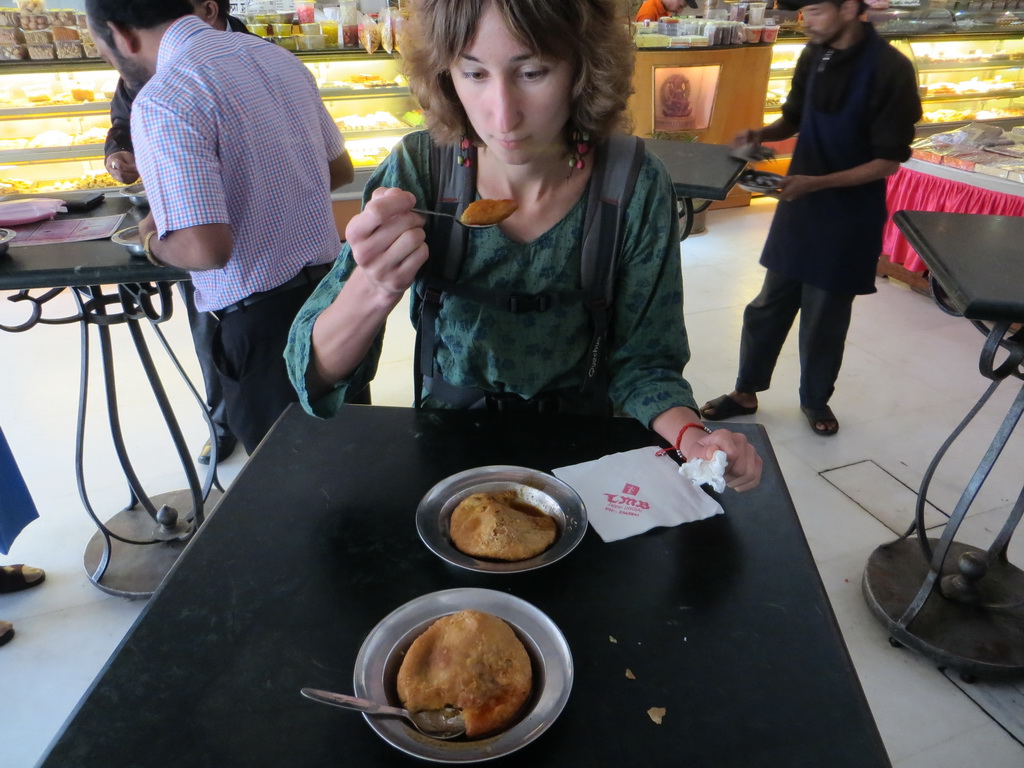
On the way, we saw a restaurant-café popular among Indians and decided to stop in. The hall was divided into two halves: on one side was a beautiful restaurant, and on the other, a café. They sold sweets by weight here, as well as a variety of fried pastries, including kachori — round fried pastries that we had already come to love. They cost twice as much here as usual, but since the place seemed civilized enough, and we were already getting hungry, we decided to have a snack. We each had a kachori, and it turned out to be large and filling.
After resting a little and regaining our strength, we continued on our way.

Day 26, February 3

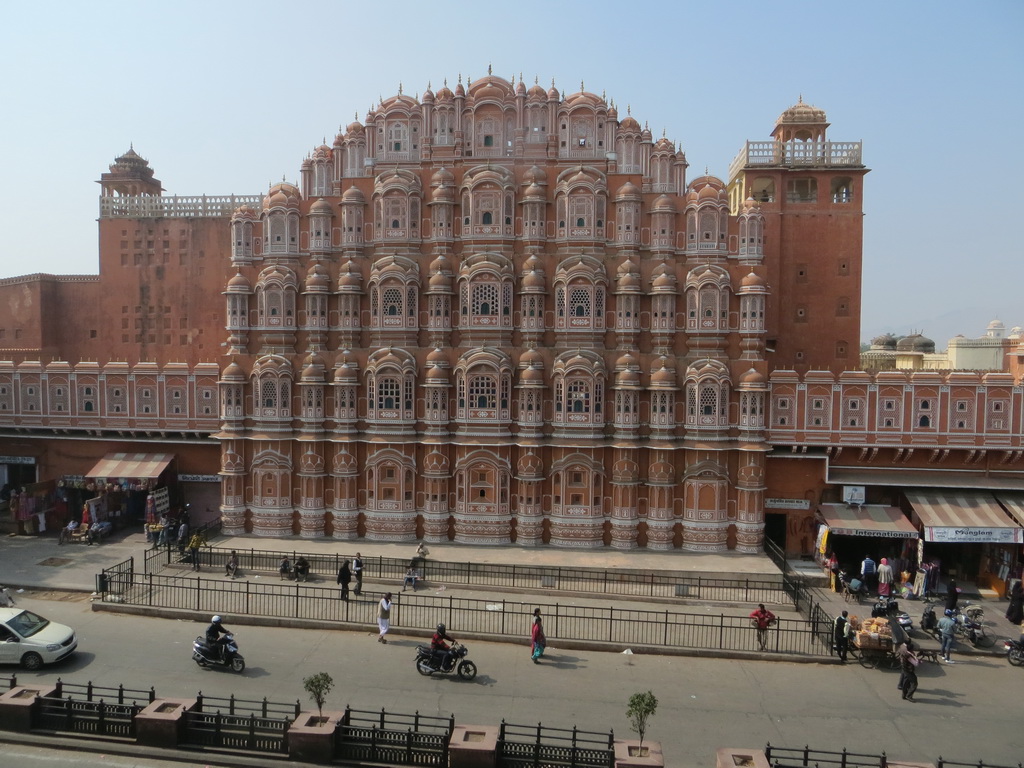
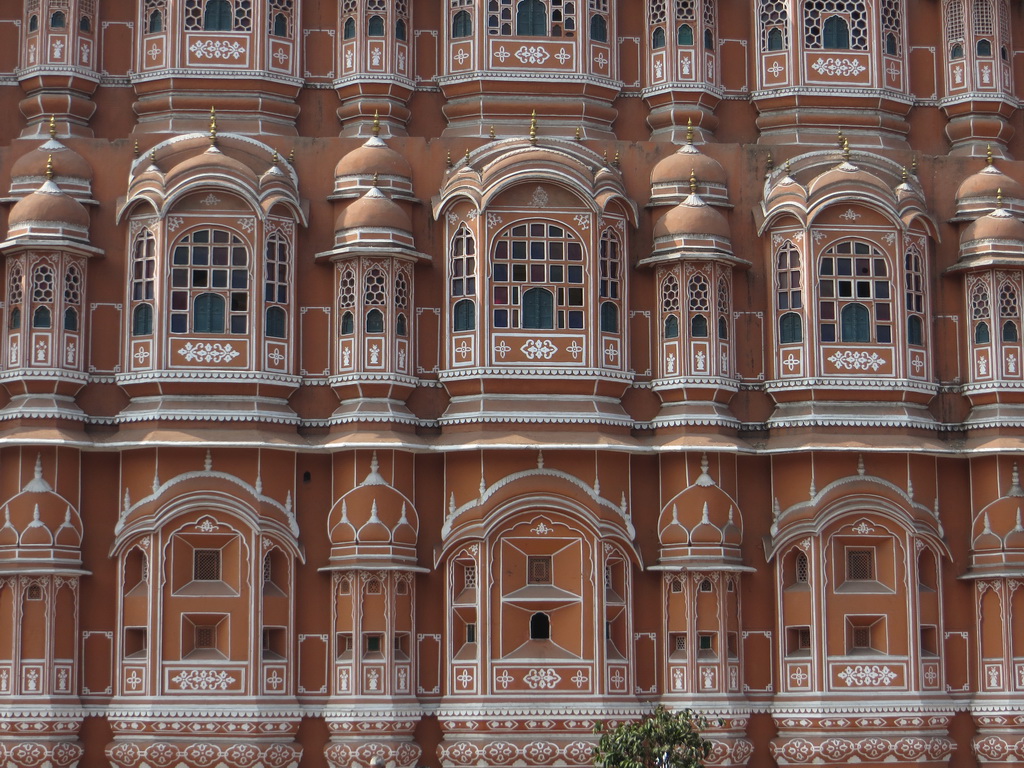
We made it to Hawa Mahal. The internet has written all sorts of things about Hawa Mahal: that it is an incomparable building, the jewel of Jaipur, the most beautiful thing in the world, and so on. And here we are standing in front of Hawa Mahal, with the thought pulsing tensely in our heads: “Is that all?”… Maybe we really have seen too much of beautiful India.
Yes, it’s a nice building, with an unusual shape. But compared to the havelis in Jaisalmer, it just quietly fades into the background. Not to mention the fairy-tale airy palaces of Mehrangarh Fort in Jodhpur, which, by the way, are made of the same sandstone. Only there the craftsmanship is much more delicate and impressive.

Day 26, February 3

Besides, in Jaipur they won’t let you just stand around and admire the beauty of something. As soon as we stopped opposite Hawa Mahal, an Indian man came up to us right away with the usual questions about where we were from and what our names were… I had read about the little staircase located between the shops right opposite Hawa Mahal. A stone staircase leads up to a rooftop with a good view of the building. This Indian man also offered to take us up there. We climbed up, and the Indian followed us. The view really was good. But it was impossible to just stand there and enjoy it because of the Indian, who didn’t stop talking for a second. After taking a couple of photos, we were getting ready to leave, and then the Indian persistently invited us into his little shop on that very rooftop — we ran away…
We went on to the City Palace. Three beautiful arches lead to the palace. Entrance to the palace is not free, 400 rupees per person, not bad…
Right there we hear Russian being spoken — we turn around, and surrounded by women stands a guy with a big belly, wearing a black T-shirt with a portrait of Putin. It’s disgusting to look at.

We decide not to go into the palace; it’s too expensive, and besides, I don’t really remember what there is to see there.
After wandering back and forth around the palace a bit, we got tired of fending off pushy tuk-tuk drivers who were trying to take us here and there. In the end, we decided to ride in one of those hybrid cycle rickshaws, sort of a bicycle, but with a little motor. The driver seemed more or less pleasant and promised to show us around the city for 40 rupees. We got in and set off. He tells us that Jaipur has many different factories: jewelry factories, textile factories, factories making cashmere items. We still didn’t quite understand where he was going with this. Then he stopped opposite one of the buildings and said:
-This is a very good silver jewelry factory, go in and have a look
-We’re not really interested in that
-No, no, it’s very interesting inside — go on, it’s free
All right, we went in. As soon as we entered the small room, a salesman immediately ran up to us and offered to take us around the factory and show us how they make jewelry. It all felt kind of disgusting, the way they kept trying to push something on you. We came out and drove on. The man took us through some strange backstreets, and we arrived at another factory — this time a textile one. Same story: “No, no, go in, have a look, it’s very interesting.”
We explained that we hadn’t come to buy anything, but to see the city, and that we weren’t going to purchase anything — so we drove on. The man seemed to understand, but then he brought us to yet another building of something else. I was already confused about which number it was and what exactly they were trying to sell us there. The driver kept saying that everything here was very cheap, unlike the bazaars. Volchiy and I thought otherwise — what if, on the contrary, the prices here were inflated.

After driving around like this for about an hour and not really seeing anything, the driver dropped us off on one of the central streets opposite a supposedly free antique museum. After paying 40 rupees, we decided to take a look inside. The museum turned out to be a little hovel with shelves piled high with antique model cars, old photographs, dishes, and jewelry dumped into boxes — all covered in a thick layer of dust. The museum owner first spoke enthusiastically about his exhibits, and when we were getting ready to leave, he persistently tried to lure us into his shop next door — “Just have a look, I have excellent trousers for you, madam.” We barely managed to escape from the museum owner too.

We went on wandering around the city. I kept being glad that we had left Jaipur “for later” — in a city like this, it’s very hard to fall in love with India. Still, by midday I had more or less gotten used to the city’s mercantile atmosphere.

Day 26, February 3

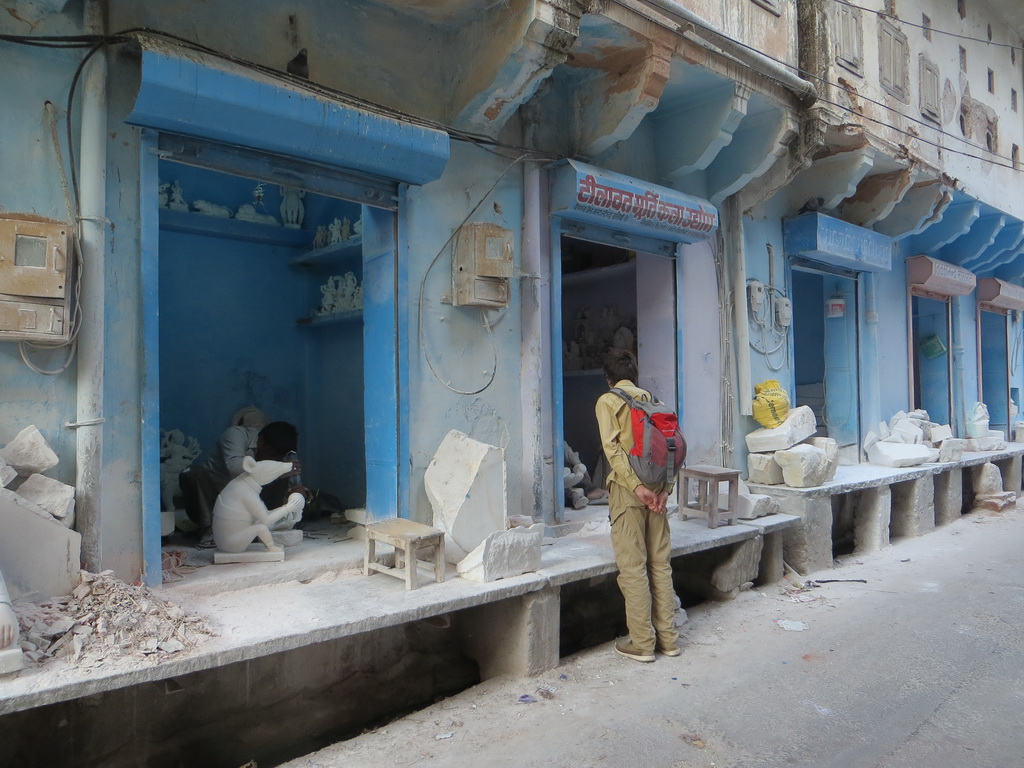
Winding through the streets — an endless bazaar — we turned into a small alley to cut the way short. The alley turned out to be very colorful: ordinary laborers here were carving various figures out of marble. These people were not at all interested in selling us anything, so we could simply stand and watch them skillfully work with stone. It’s a hellish job — very dusty, even though they work in masks — their lungs must get clogged up like crazy. In their tiny little cubbyholes, the workers were barely visible through the fine white dust.
We also drank two cups each of delicious free Indian tea right there.
We rode a little way on a cycle rickshaw, then walked and came out to the place where we had dinner yesterday. We decided not to swap one thing for another and eat here again. We ordered two random dishes and 5 buttered flatbreads — it turned out to be delicious.
We went into the pastry shop we had been to yesterday, thinking of buying some pastries instead of a cake, but on closer inspection we didn’t feel like anything. Neither I nor Volchy — we thought that was a bad sign and bought nothing.
And that was how my birthday passed. It’s hard to celebrate a birthday while traveling — you can never predict how things will turn out and where you’ll end up… Jaipur somehow wasn’t very conducive to celebrating…
Or maybe you just need your parents nearby, the people for whom it’s a real holiday….